LOS ANGELES
Guerrilla kayakers saved the LA River. Today, you can ride along with them.
Kayaking the LA River was illegal just over a decade ago
Ghawam Kouchaki/For SFGATE By Erin Rode,Contributing LA Outdoors Editor July 6, 2026
Kayakers make their way along the Los Angeles River through the Frogtown/Elysian Valley neighborhood during the tour, Sunday, June 21, 2026, in Los Angeles.
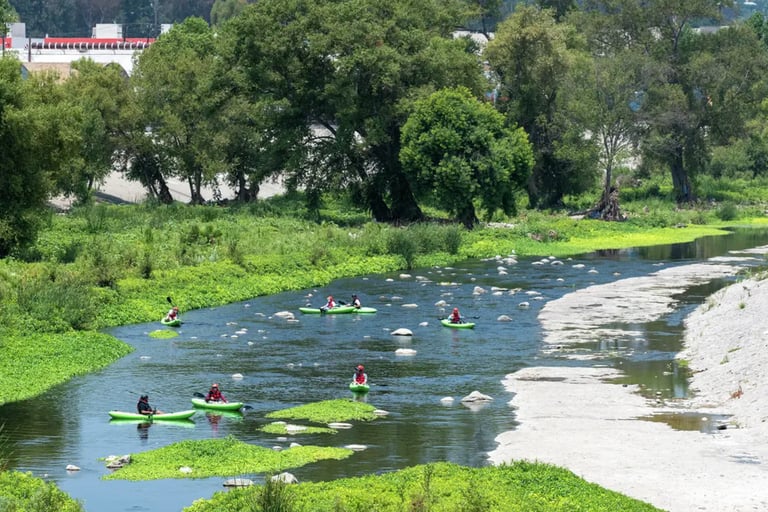
Just minutes before, I was floating in a kayak along a tranquil section of the Los Angeles River, watching a series of mini-waterfalls cascading off an island of vegetation in the middle of the waterway.
Then my kayak turned sideways and hit a rock. I fell straight into the much-maligned urban river, my brain panicking for a fraction of a second before I remembered I could simply stand up in the shin-deep water.
In a way, this is why George Wolfe, founder of LA River Expeditions, recommended I paddle through this particular section of the Los Angeles River in Elysian Valley, where the waterway runs alongside the neighborhood of Frogtown just east of Interstate 5. It’s not like I had a ton of options — kayaking is only allowed in two short sections of the 51-mile river — but of the two choices, Wolfe recommended Elysian Valley because it’s the most “startling.” The Class 1 river rapids just outside of downtown Los Angeles provide the shock factor, and the sharpest juxtaposition between a real river ecosystem and the nation’s second-biggest city, Wolfe advised.
And for most of the past 60-plus years since the river was encased in concrete, kayaking the river has been illegal.
George Wolfe, an environmental activist and founder of LA River Expeditions, shows off the Frogtown/Elysian Valley section of the route for the day’s Los Angeles River tour, Sunday, June 21, 2026, in Los Angeles.
Ghawam Kouchaki/For SFGATE
Jeff Ross, of Canoga Park, fastens the clasps of his life vest while preparing for an LA River Expeditions tour, Sunday, June 21, 2026, in Los Angeles.
Ghawam Kouchaki/For SFGATE
Jeff and Anne Ross paddle through a brush-lined section of the Los Angeles River as Jonathan Tsou follows behind them in the Frogtown/Elysian Valley neighborhood during the tour, Sunday, June 21, 2026, in Los Angeles.
Ghawam Kouchaki/For SFGATE
Less than a century ago, the Los Angeles River was free-flowing and wild, frequently changing course across a vast alluvial plain. The river could immediately transform from a tiny trickle to a raging flood during major storms; these fluctuations meant the waterway never created a deep enough channel to establish a set path. But after a series of destructive floods in the 1930s, the U.S. Army Corps of Engineers started the process of encasing the entire river in concrete, providing a permanent path for the river that Los Angeles then grew up around.
The present-day river starts in Canoga Park, then runs roughly parallel to the 101 freeway through the San Fernando Valley before making a sharp right turn near Griffith Park. From there, the river passes through Elysian Valley and downtown Los Angeles before flowing south toward Compton and eventually Long Beach, where the river terminates at the Pacific Ocean.
Just 11.3 miles of the river are “soft-bottomed,” meaning the bottom of the river is composed of natural materials instead of concrete. These 11.3 miles are broken into three sections: the Sepulveda Basin in the San Fernando Valley, the Glendale Narrows section in Elysian Valley (where I tumbled into the river) and the tidal estuary area where the river flows out toward the ocean in Long Beach.
This isn’t due to a lack of effort by the U.S. Army Corps of Engineers. The agency tried to slather concrete across the entire river bottom, but it was impossible in some sections due to higher water tables that kept the concrete from hardening. Kayak tours are also offered in the Sepulveda Basin, described by LA River Expeditions as more of a “calm, tranquil, nature-filled experience,” compared with Elysian Valley’s “sporty, gritty experience.”
Jonathan Tsou and Elyssa Santano, residents from Pasadena, prepare for an LA River Expeditions tour, Sunday, June 21, 2026, in Los Angeles.
Ghawam Kouchaki/For SFGATE
Jeff Ross and George Wolfe listen as Rudolph Secundino explains safety rules for the LA River tour, Sunday, June 21, 2026, in Los Angeles.
Ghawam Kouchaki/For SFGATE
Before my tour, Rudolph Secundino, executive director of LA River Expeditions, warned everyone that the river’s sporty nature meant we needed to stay focused on pointing our kayaks straight downstream at all times. If our kayak turned too much against the river’s flow, we might end up “baptized” by it (which is what eventually happened to me).
Throughout the 2.5-mile route, the kayaking intensity ebbed and flowed. One minute, we’d be navigating through a garden of rocks jutting out from the river; the next, we’d all pause to admire a white egret standing perfectly still in the water, only to finally take flight just as we moved past. We barely used our paddles while the current shuttled us through narrow chutes hemmed in by lush vegetation, with the river’s steep concrete banks entirely out of view — then we’d use them desperately while navigating a white-water rapid.
Secundino also had a second warning: that our little group of a half-dozen kayakers would feel like “celebrities” along the river, and we’d see people walking along the LA River Path waving and taking pictures of us in surprise. This is because, in spite of years of advocacy to increase access along the Los Angeles River, the fact that kayaking the river is possible remains relatively uncommon knowledge even among lifelong Angelenos. It’s a quirky bucket list activity for those in the know (like a family on the same tour as me, who’d purchased tickets as a Father’s Day surprise), but many others only realize it’s possible when they look down at the river often described as a glorified storm drain and glimpse bright-green kayaks in the water.
Jonathan Tsou carries his kayak with other tour participants toward the Los Angeles River in the Frogtown/Elysian Valley neighborhood at the start of the tour, Sunday, June 21, 2026, in Los Angeles.
Ghawam Kouchaki/For SFGATE
Anne and Nola Ross maneuver around rocks in their path toward the rapids along the Los Angeles River in the Frogtown/Elysian Valley neighborhood during their tour, Sunday, June 21, 2026, in Los Angeles.
Ghawam Kouchaki/For SFGATE
Kayaking is also what saved the LA River — or at least, it’s what started the long, bureaucratic process of slowly restoring sections of the river and increasing public access. Those efforts started in the 1980s, when advocates began taking actions like cutting open the fences that previously barred any public access to the river. In 2008, a guerrilla group of kayakers (including LA River Expedition’s Wolfe) forged through the entire 51-mile length of the river to help prove it was a “navigable waterway” and worthy of protection by the U.S. Environmental Protection Agency under the Clean Water Act.
The illicit kayak expedition opened a new era of recreation on the Los Angeles River and sparked a wave of federal and local efforts to both restore the river’s natural habitat and create new parks and public access points.
In 2011, the U.S. Army Corps of Engineers began allowing kayakers to use the Elysian Valley section of the river in a limited capacity and only through permitted outfitters. Two years later, the Elysian Valley section opened up for public recreational use in a limited pilot program (meaning people could kayak the stretch even without a guide, although Wolfe says people still rarely make use of this option). In 2014, the pilot program expanded to include Sepulveda Basin.
Twelve years later, the pilot program remains very much in a limited state. The Los Angeles River Recreation Zones are still contained to Elysian Valley and Sepulveda Basin, and the season generally runs from Memorial Day to Labor Day (this year, Sepulveda Basin is scheduled to remain open until Sept. 30, and Elysian Valley until Sept. 14). During those time periods, anyone can drop a nonmotorized boat into the river and head out in those two areas, as long as they use designated put-in points. Two outfitters also provide guided trips that include kayaks and gear (LA River Expeditions and LA River Kayak Safari) on limited dates throughout the summer season.
Anne Ross paddles through a brush-lined section of the Los Angeles River in the Frogtown/Elysian Valley neighborhood during the tour, Sunday, June 21, 2026, in Los Angeles.
Ghawam Kouchaki/For SFGATE
Anne Ross smiles while carrying her kayak as Nola and Jeff Ross carry theirs in the background along the Los Angeles River in the Frogtown/Elysian Valley neighborhood after the tour, Sunday, June 21, 2026, in Los Angeles.
Ghawam Kouchaki/For SFGATE
Kayakers paddle along the Los Angeles River in the Frogtown/Elysian Valley neighborhood on Sunday, June 21, 2026, in Los Angeles.
Ghawam Kouchaki/For SFGATE
The recreation program has been stymied at times by E. coli and other water quality concerns, and the city now tests the water multiple times a week during the season, using a green-yellow-red color-coded system to denote when the river is open or closed or should be entered with caution. The river was also closed for part of the 2019 season due to a bridge construction project and in 2020 due to the pandemic.
Still, even with limited access, Wolfe estimates the number of people who have set out in the Los Angeles River via kayak has grown from “only a handful of people in 2007” to around 20,000 people now. Wolfe hopes to see it expand further, in both the amount of river open for kayaking (he’s been eyeing a 3-mile stretch north of Elysian Valley near Griffith Park) and the length of the season.
Kayak season is limited in part by how fast water levels rise after a major storm; the kayaking season is planned around when these fast-moving floodwaters are less likely. In those conditions, Wolfe playfully estimated a kayaker would zoom from the start of the river down to Long Beach in just 45 minutes. Still, he hopes the seasons could be stretched just a bit outside of only May through September, expanding access opportunities to the river.
Nola Ross kayaks through the Los Angeles River in the Frogtown/Elysian Valley neighborhood at the start of the tour, Sunday, June 21, 2026, in Los Angeles.
Ghawam Kouchaki/For SFGATE
Jonathan Tsou, Erin Rode and Anne Ross kayak through the Los Angeles River in the Frogtown/Elysian Valley neighborhood during the tour, Sunday, June 21, 2026, in Los Angeles.
Ghawam Kouchaki/For SFGATE
“These are the things that kill me, because LA is park-starved,” said Wolfe, while driving a group of us kayakers to the put-in point. “And we don’t take advantage of the real assets, the real value that we have within LA. We’ve made some progress opening up some areas that were off-limits now as parks within the river corridor, but we could do so much better.” He added that “the big bureaucracy slows everything down, and makes everything excruciatingly painful and long to get accomplished.”
The Los Angeles River Master Plan, a 512-page document released in 2020 that outlines goals and actions for “reimagining” the river, is expected to take at least 25 years to implement. Priorities include creating open space along the full 51 miles of river, completing a continuous LA River Trail along the river’s length and reducing overall flood risk.
There’s been some observable progress on the river in recent years. A few gleaming new pedestrian bridges have been installed, allowing bicyclists and pedestrians to more easily cross from one side of the river to another and connecting the LA River Trail to additional parkland. And near Elysian Valley, the massive Taylor Yard project is underway to turn a former railyard into a new park, the largest park effort in Los Angeles since Griffith Park in 1896.
Still, Angelenos continually expressed that the river is lacking as a recreational asset: One poll of 600 county residents in 2021 found that of those who said they were aware of the river, a little more than half had ever visited it and only 14% had visited it many times. Of those who had visited, just 5% reported kayaking or floating in the river. “Dirty,” “dry” and “concrete” were among the top words people associated with the waterway. But Angelenos also expressed hope for a better version of the Los Angeles River; 85% said they’d be likely to visit if more parks, natural areas and recreational opportunities were added.
Kayaks are laid out at the beginning of the route, next to the bike path along the Los Angeles River in the Frogtown/Elysian Valley neighborhood, Sunday, June 21, 2026, in Los Angeles.
Ghawam Kouchaki/For SFGATE
Kayakers carry their equipment out of the Los Angeles River after the tour in the Frogtown/Elysian Valley neighborhood, Sunday, June 21, 2026, in Los Angeles.
Ghawam Kouchaki/For SFGATE
Kayakers pose for a group photo in front of dense brush along the LA River tour, Sunday, June 21, 2026, in Los Angeles.
Ghawam Kouchaki/For SFGATE
And in popular culture, the Los Angeles River still often serves as the butt of the joke — even last year, when characters actually kayaked the river in an episode of Apple TV’s “Platonic,” the river was played for laughs, with close-up shots of trash and the recreation area seemingly surrounded by power plants (which were not part of my tour through Elysian Valley).
To be clear, the occasional plastic water bottle did bob past me while navigating the river, and the overhanging tree branches in the center of the river often trap trash that’s rushed down during a major storm. But all of that mostly faded to the background as I tried to stay in control of my kayak, with wildlife usually serving as a much bigger (and more interesting) distraction.
Before hopping in the river, Wolfe had told the group this would happen: that the river takes your full focus, and other distractions or the stress of parking and lugging the kayak gear down the concrete bank would all quickly fall away. By the end of the 2.5 miles, we’d be more familiar with the river, and more easily able to respond to rocks and other obstacles.
In this way, and amid LA River bad-mouthing and slow-moving bureaucracy, kayaking through Los Angeles remains a somewhat radical act — by treating the river like a real river, Class 1 rapids and all.
LA River Expeditions is a nonprofit program fiscally sponsored by The Electric Lodge, a 501(c)(3) organization based in Venice, California. Our website is lariverexpeditions.com.
Contact: info@LARiverExpeditions.com @lariverexpeditions.com


Contact us
© 2026 LA River Expeditions. All rights reserved.